
Contents
Recently I was on a call with the two founders of a sales training firm. Good people. They charge mucho dinero to roll MEDDPICC out across a sales team. An industry-accepted framework, and a promise to personalise it to the client’s market and apply it in live deals. Then the client asks for evidence, and the industry hands over the only thing it has ever been able to count. Who attended, who finished the modules. That works if the promise is a full room. It’s not. The promise is improving win rates.
What they did not know at the time was that I had done a stint as interim CEO of Vex Power, a skills-training business built on simulators, where verifying the skill was baked into every mini course. That design came from listening to people who had bought premium courses elsewhere, from Reforge down to the growth academies that have since gone under. Their number one complaint was value attribution. They could not see the impact afterwards, because it takes a human a long time to go from consuming content to having something you could call a capability. I have also spent enough years inside enterprise deals that navigating a buying committee is second nature; I built a simulator for it, and I have skills that run sales material past a simulated committee before a real one ever sees it. So I naturally asked how they measured impact after the programme. On the actual calls, did reps ask for the economic buyer more often? Did deals with a tested champion close faster? Did anything move?
Instead of an answer, one of them told a story that has stayed with me. A client had asked them to come in and audit the deals, to sit in the pipeline and check whether the framework was being applied. They had said no. It was more work than they could deliver. That is judgment work at scale, and it is exactly the work an AI does well, if you have used one enough to know it.
That is the gap I keep seeing. The people with the edge in a craft are the last to hear what AI can do with it, because nobody who has that edge is in a hurry to share it, and the people far enough from the trenches to be curious cannot judge what they are told. So when the question arrives, what should we build, the honest answer is “I don’t know”, and the ego finds “AI can’t do this” easier to say than “I am behind”. I said the future of their business was not in the room but installed inside the client, applying the framework to every call and telling each rep, every morning, what to ask next. The best sales teams I know are already all over this, and I said that without it the business would not survive the next two years. That landed badly. They asked how. I answered, and it did not land either, because neither of them uses AI in their own work, so there was nothing to check the answer against. A few days later a list of questions arrived that read like the scope for a project nobody was paying for.
Fair enough. Here is the answer, for everyone, where I am at least paid in clout.
Forty-eight hours and a Claude Code Max plan later, it is done. A core part of their offering is now a Claude plugin you can install for free and run on your own tokens. It reads every call, email and meeting on every deal, scores each one against the eight elements with the buyer’s exact words as evidence, refuses any score it cannot quote, and briefs every rep each morning from their own calls. On a fictional pipeline of 32 deals it wrote the sentence a sales leader wants and no trainer has ever been able to give them. Since implementing FlowSales, the team applied MEDDPICC in 61% of interactions, and deals closed after it won 62% of the time, against 38% before.
That sentence is the whole story. Not because the numbers are real, they are demo data, but because they are now cheap and at speed.
The How-To Is Collapsing Into the Chatbot
If you have not put one of these tools to real work since last year, this section is for you. Everyone else can skim to the charts.
In June, Tim Ferriss published the sales figures for his own books. Four of them are how-to books, the kind that made him, and he laid the numbers out year by year against 2022, the year ChatGPT launched. Down 5% in 2023. Down 13% in 2024. Down 46% in 2025. Down 57% on this year’s run rate, which works out to roughly 80% fewer print copies in four years. The category went with him. Self-help, the trade’s word for prescriptive nonfiction, fell 26% in a single quarter this year, the steepest drop of any nonfiction shelf.
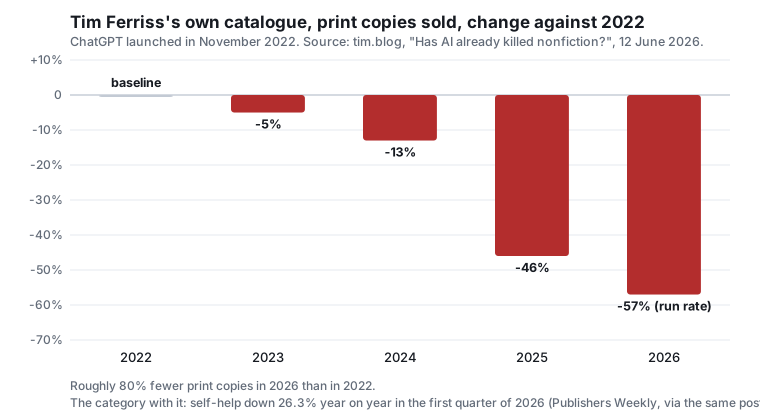
His diagnosis fits in a sentence. Why scrub through a how-to when the chatbot can hand you the steps. His own line for it is better than mine. “The market for information is collapsing into the chatbot.” He expects the market for transformation to survive, and to get smaller, weirder and more interesting. Hold on to that. It is where this article ends up.
That is the demand side. The supply side is the part people who stopped paying attention in 2024 have not caught up with. The chatbot no longer just answers. It works. METR, the lab that measures this, tracks the length of task a frontier model can finish on its own half the time, timed by how long the same task takes a person. When ChatGPT launched, that was about thirty seconds. By early 2025 it was an hour. By the end of 2025 the best model was past five hours. In February it was twelve. By May it had gone above sixteen, past the point where METR trusts its own task suite. I have watched the same curve from the inside. Since February I have been using Wiggum loops and homegrown harnesses to one-shot books overnight, and it keeps getting faster. Claude Code now ships with loops and multi-agent workflows built in, so you no longer need a harness of your own to have a swarm of agents crank out an unreasonable amount of work while you sleep.
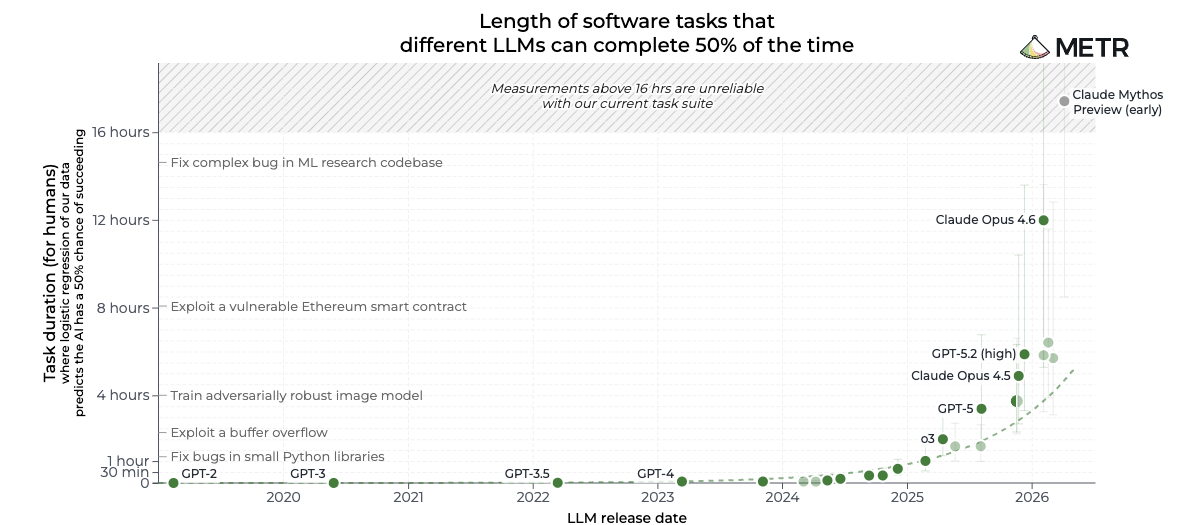
The point is that “long-running” stopped being a claim and became a setting.
Put the two sides together and the sentence that matters falls out. AI does not shorten the time it takes a human to learn a skill. It dissolves the need to learn it, wherever the AI can simply do the thing. That is why the how-to book is dying, and it is exactly why a sales programme that charges mucho dinero is exposed. What the programme sells is not information. MEDDPICC fits on a page and has been public for decades. What it sells is discipline. Did the rep ask the metrics question, test the champion, map the paper process, on this deal, this week. Information collapsed into the chatbot. Discipline collapses into the plugin.
What FlowSales Does
FlowSales is a Claude plugin. You install it in the Claude desktop app or in Claude Code, point it at your HubSpot and wherever your calls live, Granola, Gong, Fireflies or a folder of transcripts, and it runs inside your own Claude on your own tokens. Nothing leaves your machine except the text sent to the model for scoring, and it never writes to the CRM. Six commands, one loop. Setup once. Audit for the benchmark, then weekly. A daily sync for each rep every morning. A retro every week. Impact every quarter. Status whenever you are not sure it is working.
The audit is the engine. It reads every call, email, meeting and note on every deal in the window and scores each one against the eight elements of MEDDPICC, in time order, knowing which phase the deal was in at the time, so nobody is marked down for skipping the paper process on a discovery call. The scale runs from zero to three. Zero is nothing in the text. One is the rep asserted it, or the buyer was too vague to act on. Two is the buyer said it, specifically, one source. Three is a second buyer-side person, an artefact or an action. Anything above one needs the buyer’s exact words, copied from the transcript, and a validator checks the quote is really there. If it is not, the score drops to one and the element is flagged. The rubric the judge follows is a file you can read and edit.
Then the part no call scorer I have seen does. It counts the rep’s behaviour separately from the buyer’s evidence. Did the rep ask the metrics question, test the champion, ask for time with the economic buyer, on this call. A buyer who volunteers a perfect answer while the rep says nothing is high evidence and zero adoption. That split is what turns a call scorer into a training measure, because adoption, the share of calls where the rep applied the framework, per element, per week, before and after the training date, is the number the industry never had.
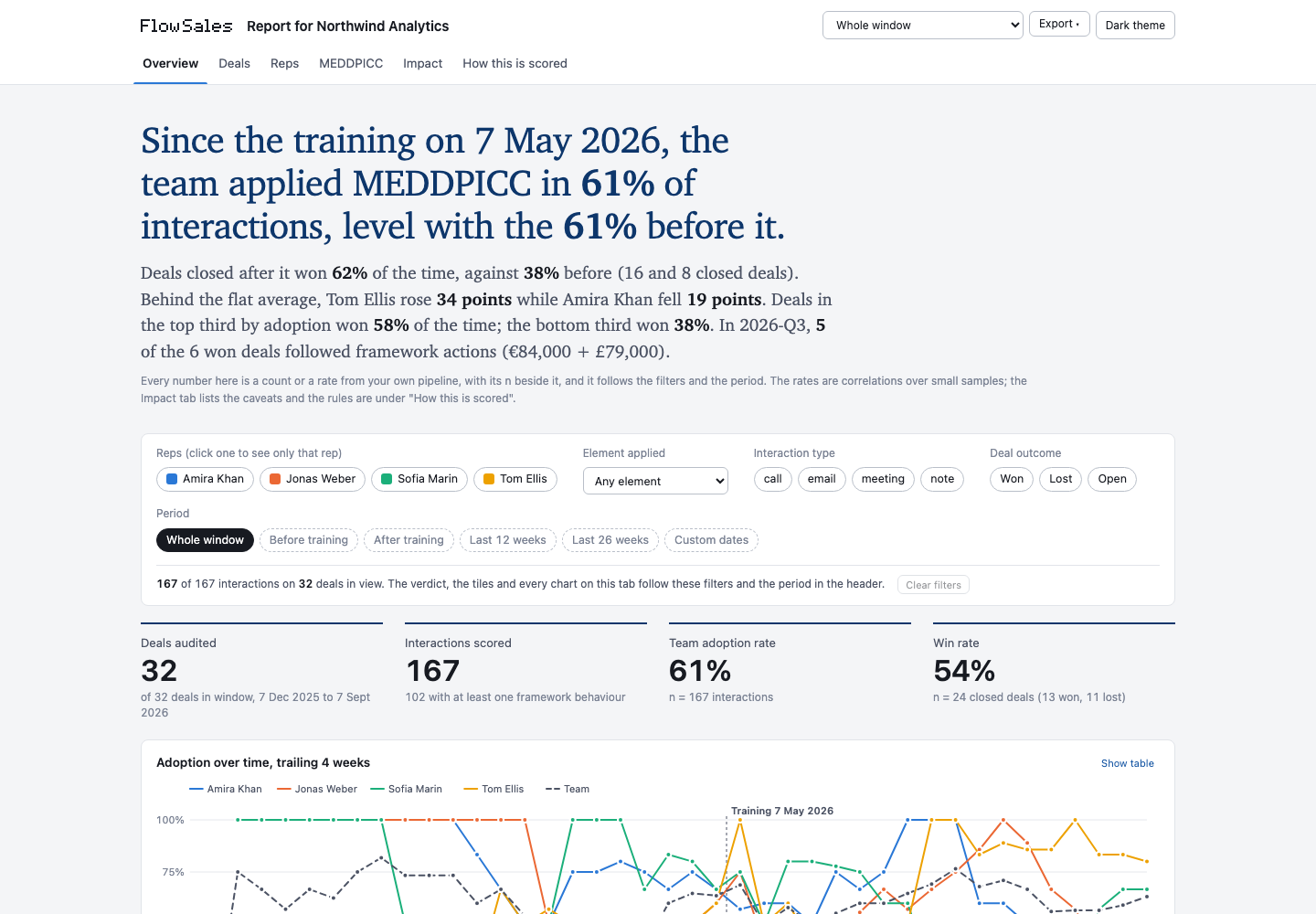
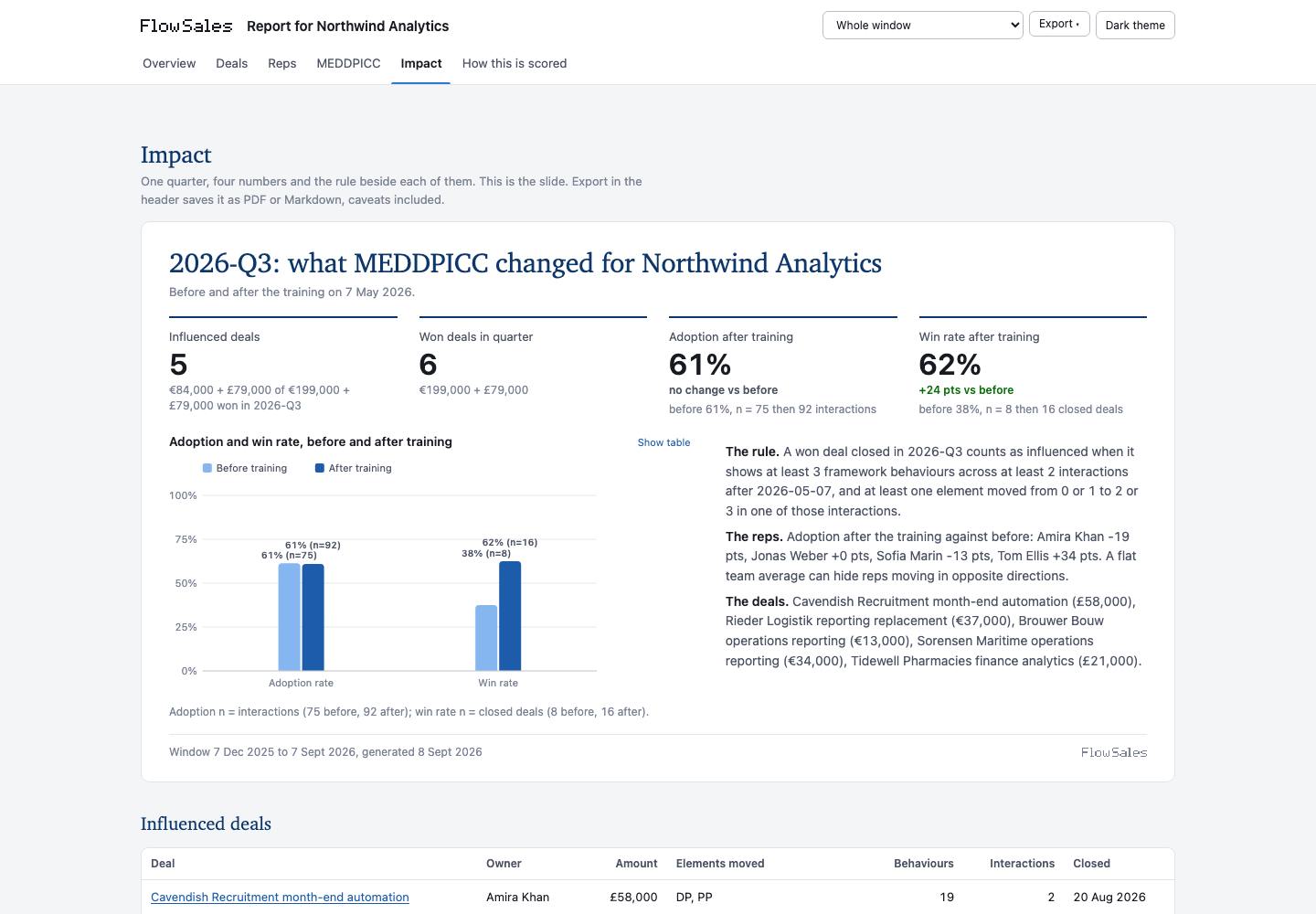
For the person who runs the team, the report is one file you open in your browser, and you can download it as a PDF, or as Markdown if you want to feed it back into an AI. It opens on a verdict written from your own pipeline, the sentence you read in the intro, and every number under it is a count or a rate with its n beside it. Filter by rep, element, interaction type, outcome or period and the whole page recomputes, verdict included. Every deal is a row with its eight levels and its gate, and every deal has a page that shows the evidence decaying with dates, why a score is not higher, and the next question to ask.
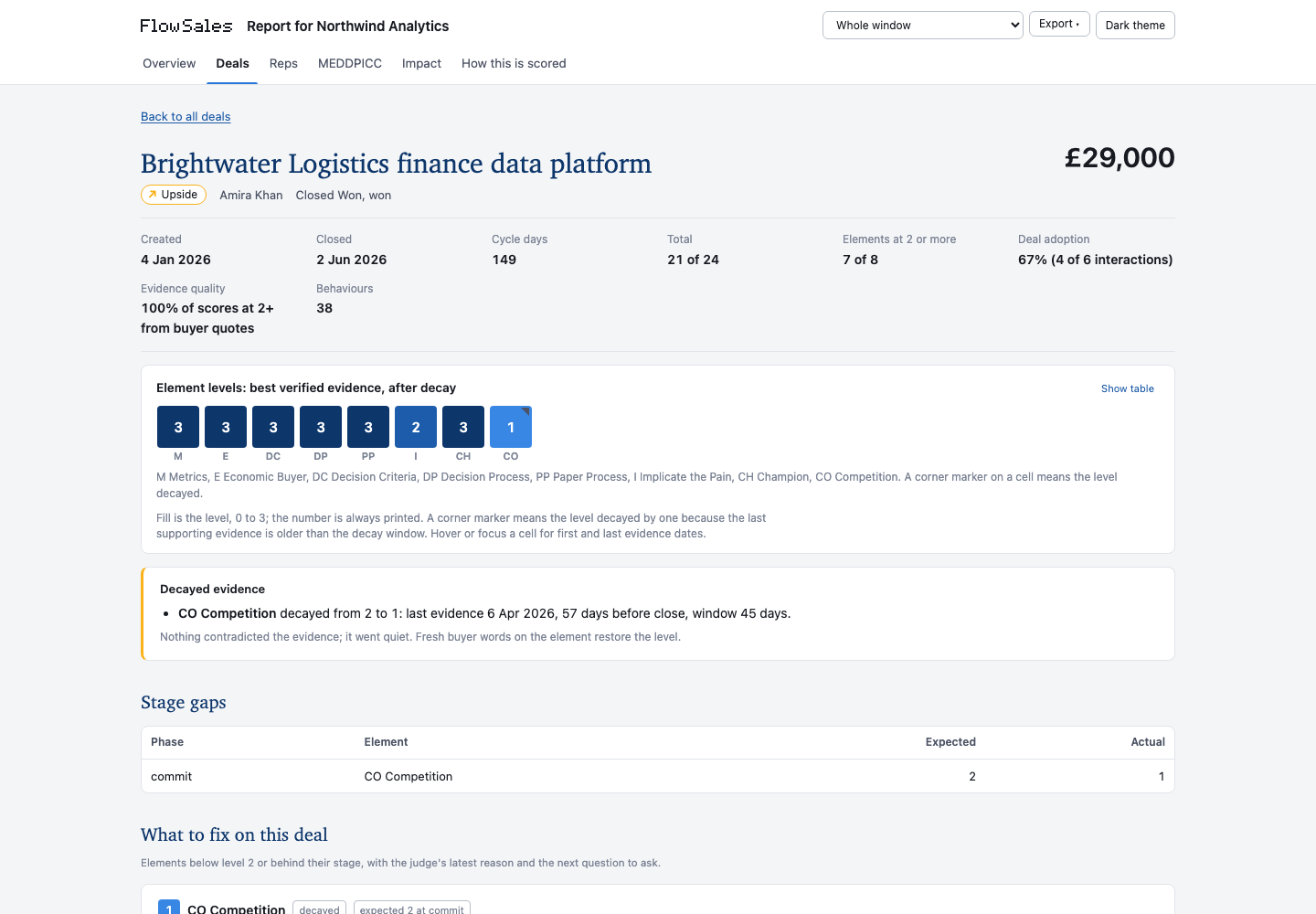
Each rep has a card with the three elements to practise, and every recommendation cites the deal and the date where the gap shows.
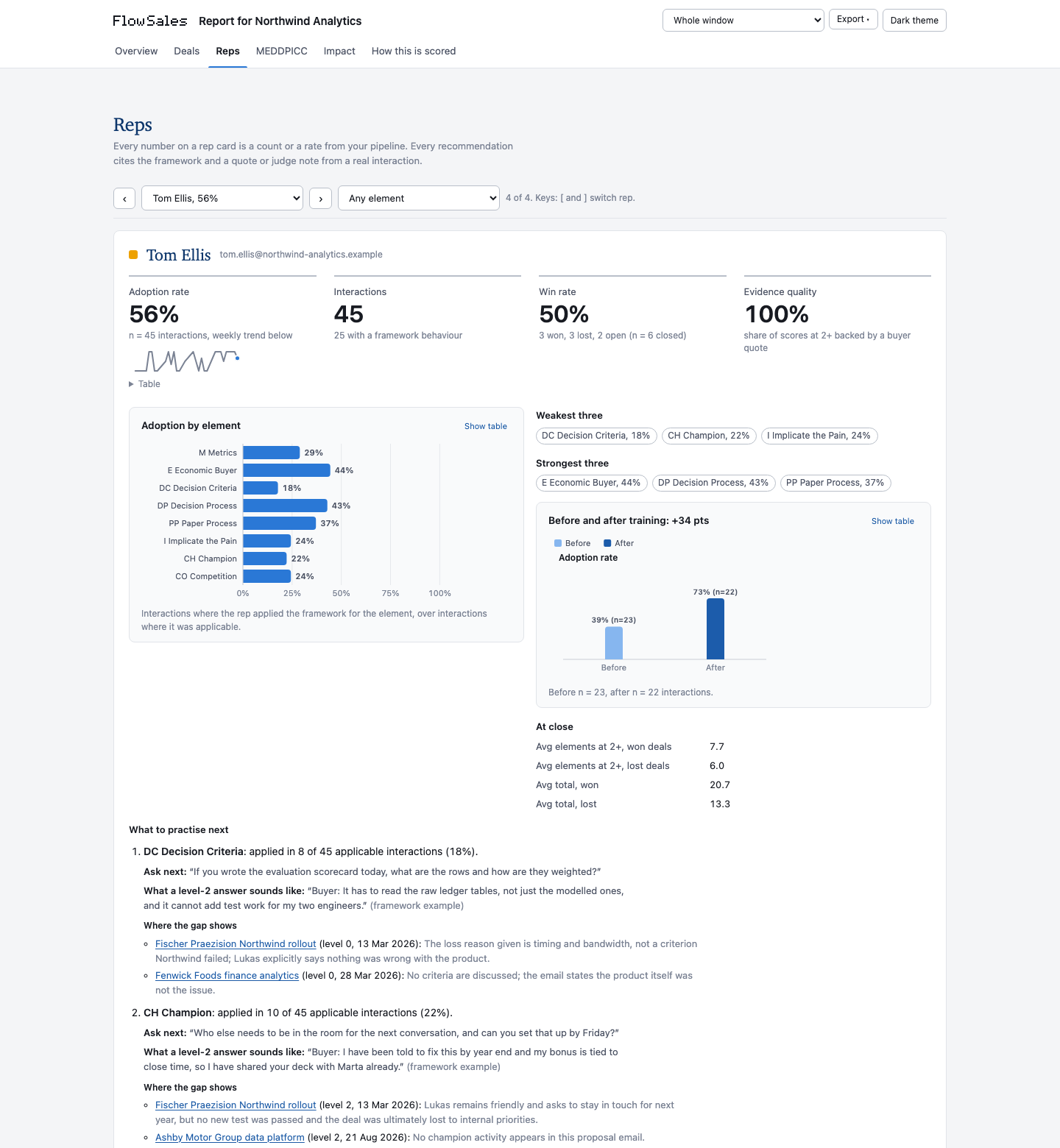
The impact tab is the slide. One quarter, four numbers, the rule beside each, and it exports with the reps’ names hidden for anyone outside the sales team.
For the rep, the product is two minutes every morning. The daily sync pulls only their own deals since yesterday, reuses whatever the team has already judged, judges what is new, and then, before it shows a single piece of evidence, asks the rep where each live deal stands. Only then does it show them the calls. The gap between what they believed and what the buyer actually said is the coaching, and the briefing is written in their voice, deal by deal, with the question to ask next. One of the two founders raised an objection on that call that I have not been able to shake, that telemetry telling a rep “you asked the question” undoes the conscious competence a training exists to build. He was right, and this is the answer to it. The rep goes first.
Here is what that looks like on the wire for a team of three, one Tuesday morning. Each person pulls their own deals, checks a shared folder for deals a teammate has already judged, pays to judge only what is new, and copies the result back for everyone else.
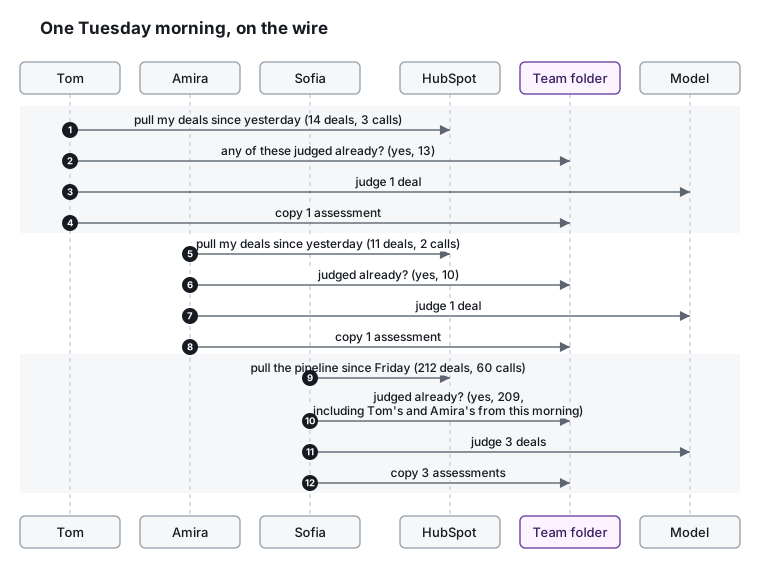
Three small pulls instead of three full ones, and five deals judged instead of 237. If the folder did not exist every line would still run; Sofia would judge 41 interactions instead of 3, and that is the whole penalty.
This is the demo briefing for Tom Ellis, one of the fictional reps, trimmed to one deal.
Ashby Motor Group data platform (Decision Maker Bought-In, £73,000): 8 of 8 elements at level 2 or more; Economic Buyer and Champion sit at 2, and the commit gate wants both at 3. Nothing on the record since 21 August.
Next move: "Hannah, has Sarah confirmed the review, and what does she need from us before the board paper goes in?"
Why: on 11 August Hannah said "I will forward the invite to Sarah and warn them it is coming", and nothing since shows Sarah in the room.
One thing to practise today. Champion. It is your least-applied element on live deals, applied in 10 of 45 interactions. The move on Ashby is a test, not a compliment: "Hannah, would you be comfortable walking Sarah through the connector answer without me on the call?" If the answer is yes and it happens, Champion moves to 3 and the deal clears the commit gate.
Your Six-Figure Programme Is Now a Download
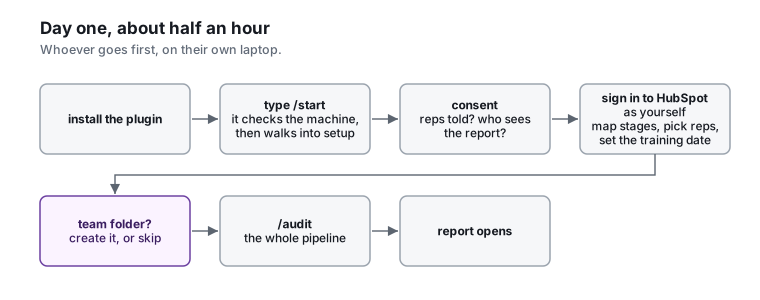
Here is the whole install. Day one, for whoever goes first, fits on one line, and nothing needs admin rights.
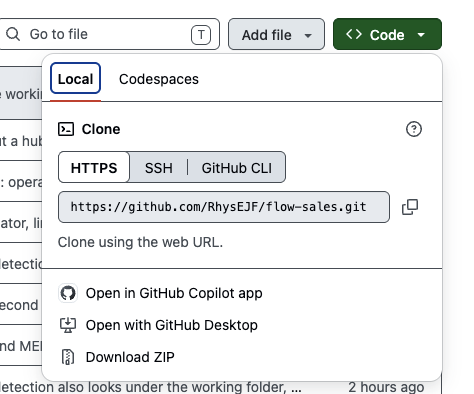
- Get the plugin from github.com/RhysEJF/flow-sales. The green Code button, then Download ZIP.
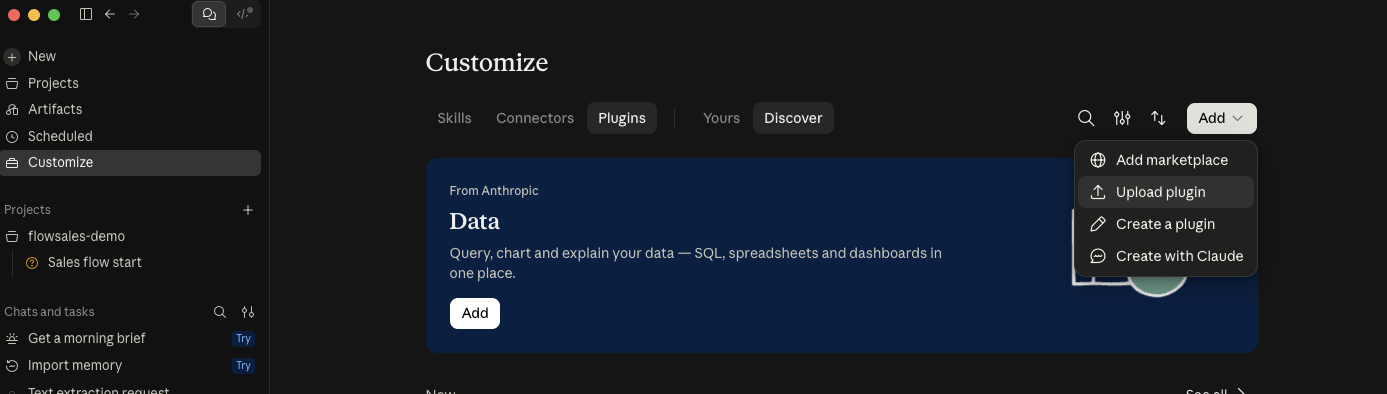
- Open the Claude desktop app. Customize, then Plugins, then Add, then Upload plugin. Pick the zip. You will see ten skills, two connectors and one agent.
-
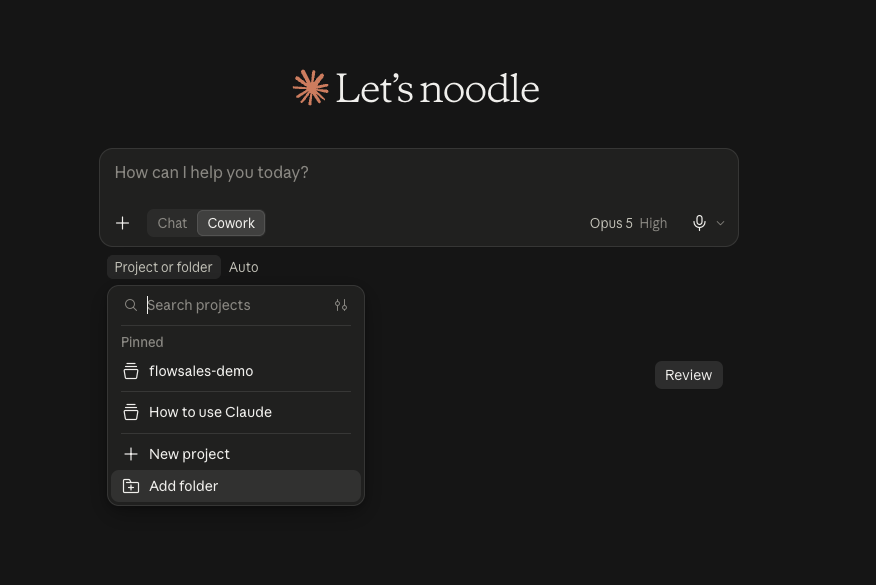
Start a Cowork session and add an empty folder. Pick Opus while you are there. That folder is where FlowSales keeps everything. Delete it and it forgets.
A tip if you want it to outlive the laptop. Put that folder inside Google Drive, or whatever your team syncs. The store is plain JSON files, so a synced drive handles it fine and everything in it survives. Two caveats. The transcripts and CRM data are in there, so use a private folder, not a shared one. And Cowork sessions that run in the cloud have no disk of yours, so this is for local sessions only.
- Type
/start. It checks your machine first, then walks you into setup. Add--demoif you want to try it on 32 fictional deals before your own.
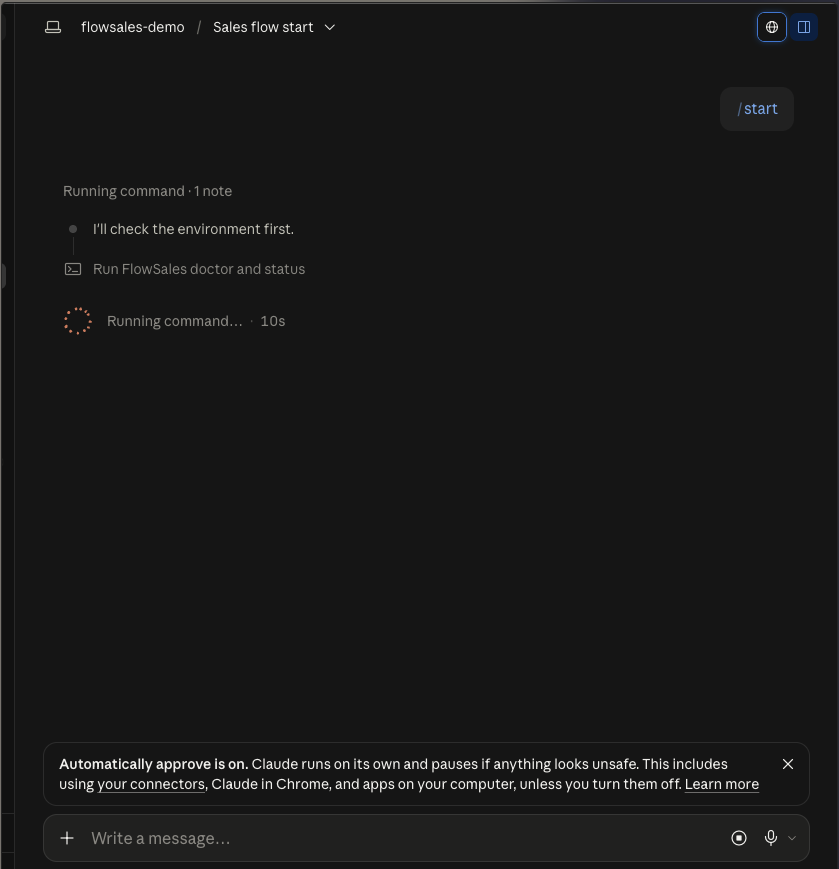
- Let it guide you through the setup list. Eight steps, one question at a time. Who you are, whether the reps have been told and who will see the report, which sources to use, the framework and the time window, then a sign-in to HubSpot as yourself. No token, no admin. It ticks each step off as you answer.
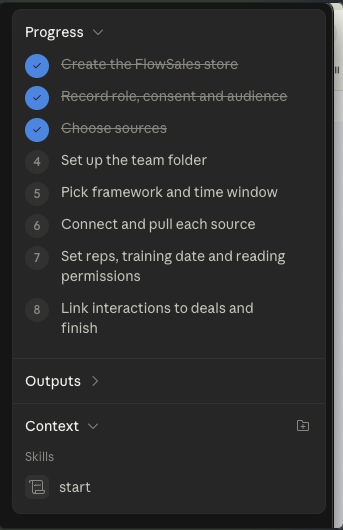
- Type
/audit. It links the calls to the deals, scores them in Sonnet sub-agents five at a time with a line per deal as they finish, and opens the report. About seven minutes for 32 deals. - From then on a rep types
/daily-synceach morning and a manager runs the audit each week.
For a team, nothing changes except one folder. Every machine keeps its own store and pulls for itself, so nobody’s morning depends on a colleague and nobody runs a server. The only thing shared is the judged assessments, because those cost tokens to produce, and they travel through a folder the team already syncs on Drive or OneDrive. Setup offers to create it, or finds it on its own. It holds scores and quotes only, never the calls or emails, which is why it can be shared when the store in step 3 must not be.
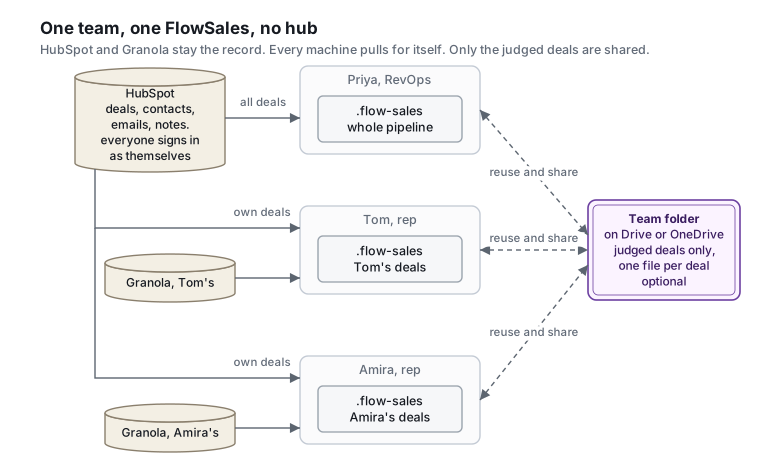
Freshness never comes from the folder. It comes from each machine’s own pull, which is small and takes seconds.
That is it. Follow the steps and it runs it for you. If you would rather have a hand with the first run, that is what training is for.
Everything in this article is free. The plugin, the rubric, the design notes.
If you run a sales team, follow the steps and see what your own calls say. If you sell training, or anything else whose value is delivering content, and you would rather be the one who writes the rubric than the one competing with a download, book a call.
If this was useful
One email a week on what we deployed, what broke, and what it taught us.
One email per week. Unsubscribe anytime.
Swarm Operators is a private circle of operators, builders, and leaders dissolving cognitive bottlenecks. Entry by application.
Three short questions follow, then a human reads your application.
Comments